

Bioactive secondary metabolites (natural products) are produced by every domain of life, ranging from bacteria, to plants, and to animals. Importantly, they have been critical to the development of new drugs, with nearly 50% of FDA approved drugs having their roots in natural product chemistry. Moreover, detailed study of the biosynthesis of many classes of natural products has revealed exciting enzymology not observed in primary metabolism.
The Chekan Lab is focused on the discovery of new natural product biosynthetic pathways and uncovering the details of the enzymes that produce them. In particular, the Chekan Lab studies the Ribosomally Synthesized Post-translationally Modified Peptide (RiPP) class of natural products. As their name suggests, RiPPs take peptides made by the ribosome and then use tailoring enzymes to modify them into complex, bioactive structures. The final compounds contain a wide variety of bioactivities including antibacterial, antimalarial, metal chelating, and cell signaling. By combining bioinformatics, genome sequencing, protein biochemistry, structure elucidation, and chemical synthesis, the Chekan Lab aims to discover new RiPP compounds and connect known compounds back to their biosynthetic gene clusters.
In addition to discovery, the Chekan Lab is also interested in engineering new RiPP pathways, enzymes, and novel compounds with the goal of identifying new drug leads.
Research

While plants are well known producers of alkaloids, terpenoids, and polyketide secondary metabolites, they are also prolific producers of peptidic natural products. Our group focuses on an emerging class of plant produced cyclic peptides. While the structural scaffolds of these plant natural products vary, they are characterized by diverse crosslinks between the side chains of aromatic amino acids and another nearby amino acid. Even though molecules in this family have been known for decades, little is known of their biosynthesis. Using a combination of transcriptomics, metabolomics, and transient expression in plants, we are working to fully elucidate these biosynthetic pathways.
See our publications here:
Lima, S. T.*, Pasquale, M. A.*, Noyon, M. R. O. K., Clark, E. A., Laws, C. R., Hematian, S.#, and Chekan, J. R.# (2025) Peptide recognition sequence guides catalytic side chain cross-linking of plant peptides by copper-dependent cyclases. J. Am. Chem. Soc. 147, 20284–20293 (doi: 10.1021/jacs.4c15470)
Kriger, D.*, Pasquale, M. A.*, Ampolini, B. G.*, and Chekan, J. R. (2024) Mining raw plant transcriptomic data for new cyclopeptide alkaloids. Beilstein J. Org. Chem. 20, 1548–1559 (doi: 10.3762/bjoc.20.138)
Chekan, J. R.#, Mydy, L. S., Pasquale, M. A., and Kersten, R. D.# (2024) Plant peptides – redefining an area of ribosomally synthesized and post-translationally modified peptides. Nat. Prod. Rep. (doi: 10.1039/D3NP00042G)
Lima, S. T.*, Ampolini, B. G.*, Underwood, E. B.*, Graf, T. N., Earp, C. E., Khedi, I. C., Pasquale, M. A., and Chekan, J. R. (2022) A Widely Distributed Biosynthetic Cassette Is Responsible for Diverse Plant Side Chain Cross-Linked Cyclopeptides. Angew. Chem. Int. Ed Engl. (doi: 10.1002/anie.202218082)
The Chekan Lab is focused on the discovery of RiPP natural product biosynthetic pathways and uncovering the details of the enzymes that produce them. As their name suggests, RiPPs take peptides made by the ribosome and then use tailoring enzymes to modify them into complex, bioactive structures. The final compounds contain a wide variety of bioactivities including antibiotic, antimalarial, metal chelating, and cell signaling. Recent work has shown that there are many families of RiPPs waiting to be discovered. To accomplish this, the Chekan lab takes a bioinformics first approach to identify gene clusters that appear to encode for new RiPP natural products. We then evaluate this hypothesis by heterologously expressing both proteins and clusters in bacteria and rigorously examine the biochemical details of these new enzymes. To complement this in vitro approach, the authentic natural product from the original producing organism is isolated, characterized, and evaluated for bioactivity.

See our publications here:
Rajput, A.*, Butler, K. S.*, Springer, D. A., and Chekan, J. R. (2025) Indolylamide macrocyclization by a Streptococcus pneumoniae ThiF-like enzyme family member. Org. Lett. 27, 5765–5770 (doi: 10.1021/acs.orglett.5c01561)
Hubrich, F., Kandy, S. K., Chepkirui, C., Padhi, C., Mordhorst, S., Moosmann, P., Zhu, T., Gugger, M., Chekan, J. R.# and Piel, J.# (2024) Ribosomal peptides with polycyclic isoprenoid moieties. Chem. (doi: 10.1016/j.chempr.2024.07.026)
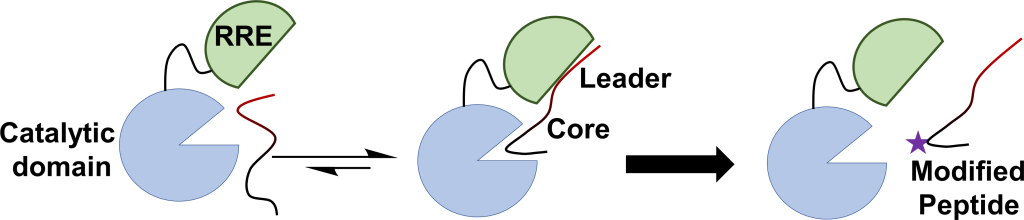
In addition to discovery, the Chekan Lab is also interested in engineering new RiPP pathways, enzymes, and novel compounds with the goal of identifying new drug leads. Many RiPP biosynthetic enzymes found in nature contain two domains. One is responsible for binding to the leader portion of the peptide substrate and is called the RiPP Recognition Element (RRE). The other domain catalyzes modification to the core peptide to generate the product. This two domain architecture has the advantage of separating substrate binding from catalysis and produces an enzyme that can perform chemistry on a wide range of peptide substrates. The Chekan lab is working to exploit this feature of RiPP enzymes by engineering new peptide modification enzymes that can be added to existing RiPP pathways or combined together to create novel RiPP pathways not found in nature. Ultimately, these engineered RiPP enzymes will be used to develop new bioactive RiPP natural product analogs.
See our publications here:
Smith, A. B., and Chekan, J. R. (2024) Targeted peptide modification using an engineered bacterial N-glycosyltransferase. ACS Catal. (doi: 10.1021/acscatal.4c01958)