Pazicni, S.,* Popova, M., Making the case for inorganic chemistry education research: Insights from symmetry, Comments on Inorganic Chemistry, 1–19. https://doi.org/10.1080/02603594.2025.2523259
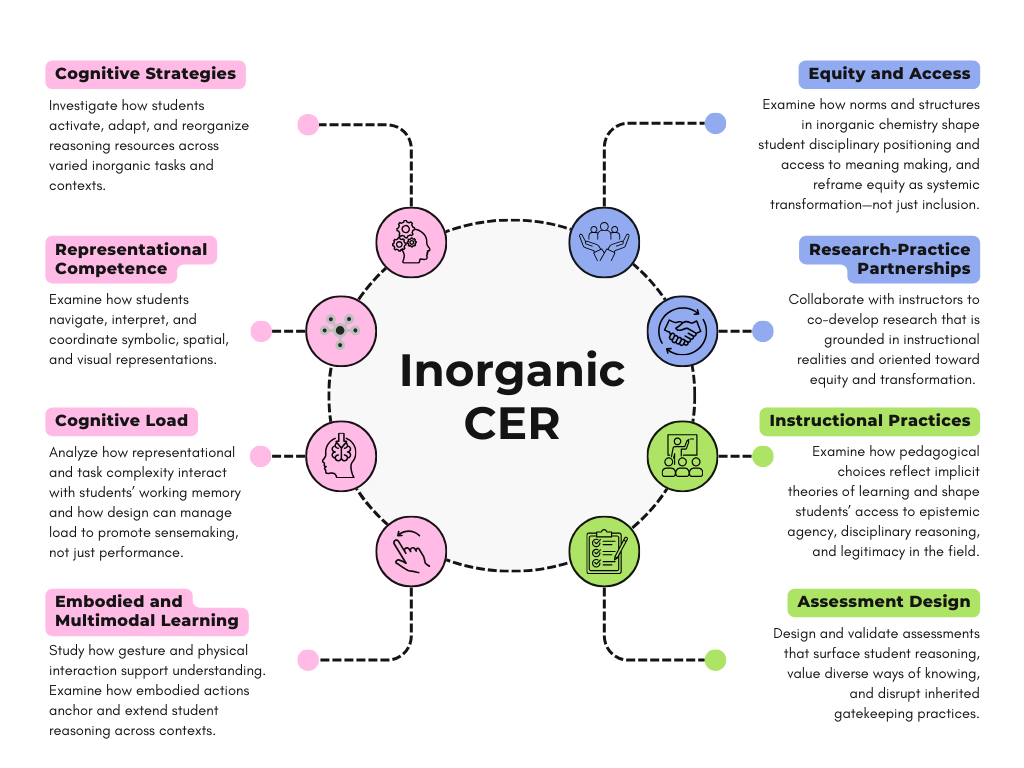
Chemistry Education Research has transformed how we understand and improve student learning in general and organic chemistry, but inorganic chemistry remains understudied. This gap persists even though inorganic instruction involves complex representational demands, spatial reasoning, abstract formalisms, and instructional traditions that shape how students experience the subject. Using molecular symmetry as a case study, this contribution argues that research on teaching and learning must attend more closely to inorganic chemistry. We outline how challenges in student cognition, instructional design, representational tools, and instructor assumptions interact in ways that affect learning but remain poorly understood. Drawing on frameworks from cognitive psychology and learning sciences, we highlight the need for systematic, discipline-specific investigations into how students learn and how instructors teach key inorganic concepts. Finally, we offer a research agenda that extends beyond symmetry to areas like bonding theory, coordination chemistry, and solid-state structures. By investing in a robust teaching and learning research program for inorganic chemistry, we can develop instructional strategies grounded in empirical evidence, improving student learning and supporting the evolution of the discipline.