Our research group primarily focuses on using analytical tools to advance our knowledge in specific areas that are related to our health and living environments. Specifically, our current projects include the following:
Method Development
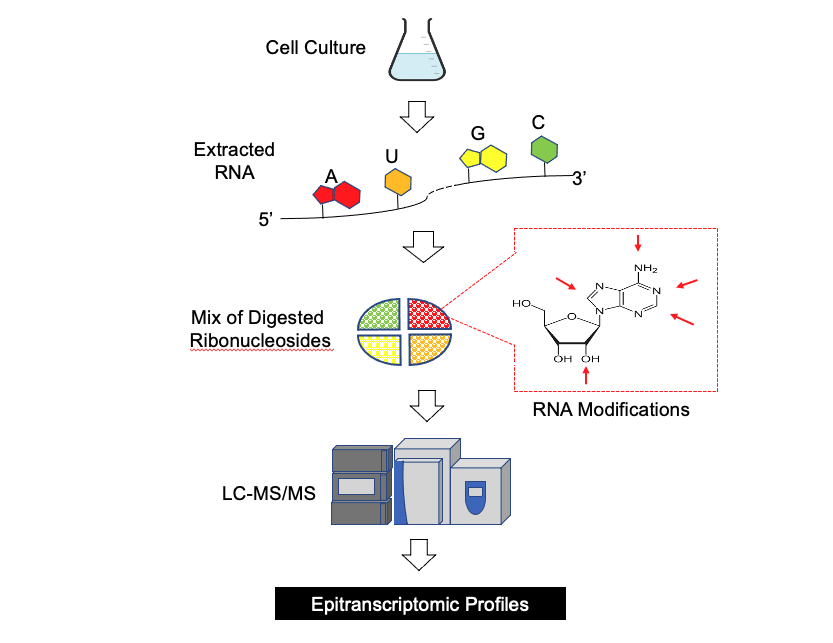
Since establishing our research group, the development of new or improved analytical methods has continued to be one of our focuses. For the end-point measurements in our developed methods, mass spectrometry has been commonly used. To address the challenge of analyzing isomeric compounds, the coupling of ion mobility spectrometry to mass spectrometry has been explored. Currently, we are interested in improving the accuracy for quantifying RNA modifications as well as shortening the time required for analyzing each RNA sample. The goal is to provide a set of methods for studying the roles of RNA modifications (or epitranscriptomes) in various cellular activities.
Disease Biomarkers
The benefits of being able to detect specific disease biomarkers include the prevention, diagnosis, and/or treatment of diseases. However, the analysis of specific disease biomarkers is often restricted by the limited amount of samples that can be collected from an individual patient. This is further complicated by the complex contents in the sample of interest and/or the low abundance of targeted biomarkers. To improve our ability in the qualitative and quantitative analysis of specific disease biomarkers, our group has explored the use of different approaches and analytical techniques. By collaborating with the Tannous group at the Massachusetts General Hospital, we have initiated an effort to identify new RNA biomarkers for brain cancer by using high resolution mass spectrometry. This project is currently funded by NIH.
Prevention of Suicidal Behaviour
Despite the strong support and help from our government and communities, the suicide rate among veterans remains higher (~52%) than that for non-veteran adults in the US. A recent publication from the United Service Organization reports the suicide rate among active service members has been increasing over the past five years. In our collaboration with Drs. Maloney and Goolkasian, we are currently exploring a new way to lower the rate of suicide among veterans and active service members.
Nanotoxicity
By using whole cell mass spectrometry, we are interested in developing a high throughput screening method for the cytotoxicity of nanomaterials. Through a collaboration with the Jia group at UNCG, we have also participated in a study to explore the applications of carbon-based nanomaterials in the prevention and treatment of heart disease. This project is currently funded by NIH.
Research
References:
Wang H, Simpson J, Kotra M, Zhu Y, Wickramsinghe S, Mills D, Chiu NH*. Epitranscriptome of Lactobacillus agilisand its adaptation to growth on inulin. BMC Res. Notes14, 154-59 (2021).
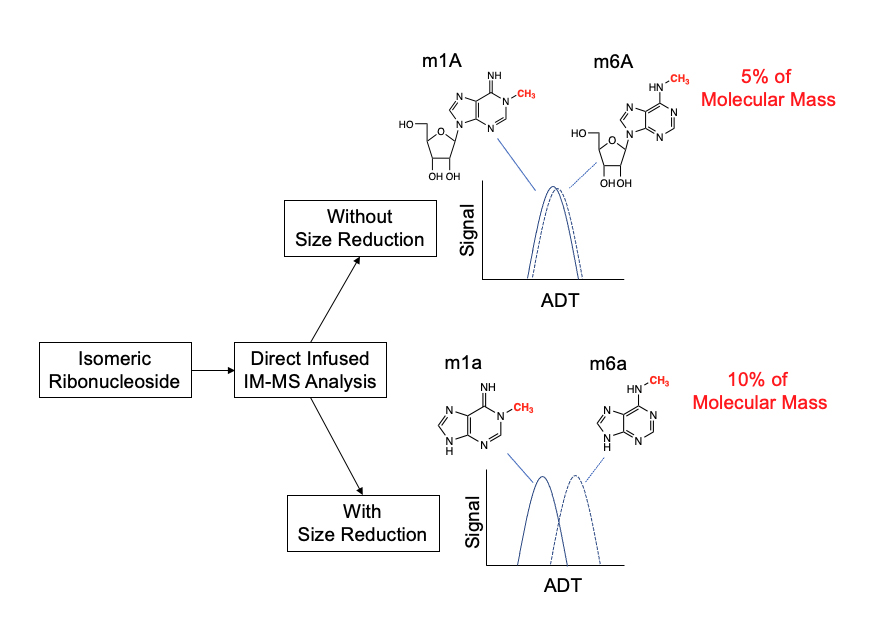
The possibility of using ion mobility spectrometry (IMS) to differentiate different sizes or shapes holds a great potential to improve the detection of isomeric compounds. However, due to the lack of sensitivity and inadequate resolution, IMS has not been fully utilized in the analysis of various types of isomers, including RNA modifications. The goals of this study are to explore a way to achieve a more effective IM separation by reducing the size of ions prior to the IM measurements, and apply the improvement to enhance the accuracy for identifying specific isomeric RNA modifications. Using RNA methylation as an isomeric model, the proposed method can lower the required resolution by approximately 20%. The benefits of using the proposed method include adding the result of IM measurements as an extra dimension to the data set, such that the accuracy for the identification of isomeric RNA modifications is improved. In comparison to the results obtained from using the conventional MS/MS method on the same platform, there is no significant loss of ion signals when the proposed method was used. The proposed method is expected to be applicable to other types of isomeric compounds. Also, the same methodology is applicable on other ion mobility platforms.
References:
Wang H, Todd DA, Chiu NH*. Enhanced differentiation of isomeric RNA modifications by reducing the size of ions in ion mobility mass spectrometric measurements. J. Anal. Sci. Technol., 11, 46-56(2020).
Despite the development of laboratory automation, the time and costs for carrying out various types of toxicity assays with each compound of interest remain as a burden. Thus, it limits the extent of an investigation. We have recently developed a high-content mass spectrometric (MS) assay for untargeted in vitro toxicity. In the MS assay, high resolution mass spectrometry is used directly to acquire a unique spectral pattern from living cells that have been exposed to a compound of interest. Each spectral pattern includes multiple signals of different molecular ions and their signal intensity, which combine together corresponds to a specific cellular response from a cell culture that has been exposed to the compound of interest. By comparing the spectral patterns, cellular samples with or without any treatment could be differentiated. Also, cellular samples that had been treated with different chemicals or dosage levels could be distinguished from each other.
